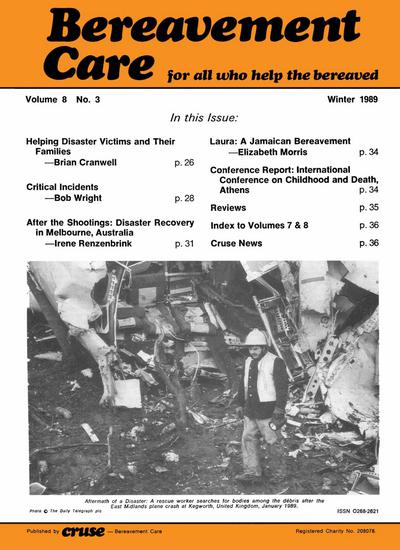
After the Shootings: Disaster Recovery in Melbourne, Australia
Abstract
AbstractThe mass shootings in Clifton Hill and Australia Post Headquarters within the space of four months in Melbourne, Australia in 1987 presented unique challenges for disaster recovery planners and workers. The violent and random nature of both incidents tested previously-held beliefs about disaster planning and the interventions required to mitigate the effects of trauma. While crisis intervention models provide useful conceptual frameworks, the Incorporation of a loss and bereavement model can add a more holistic and humane perspective for service provision and community education. This paper will describe the recovery process following both shooting incidents, the challenges and conflicts inherent in recovery work, and the ways in which affected people were assisted. Many of the losses experienced by survivors and helpers alike cannot be restored nor quantified. information, support and care enables those affected to make sense of chaotic and painful events which have rendered them helpless and vulnerable. As a social worker for a company of Funeral Directors and as a member of one of the affected communities, the author brings a depth of understanding to the processes involved in disaster recovery.
References
Raphael, B. 1986. When Disaster Strikes: A Handbook for the Caring Professionals London: Hutchinson.
Worden, J W. 1983. Grief Counselling and Grief Therapy London: Tavistock Publications.
Simos, B. 1979. A Time to Grieve: Loss as a Universal Human Experience Family Service Association of America.
Parkes, C M. 1983. Recovery from Bereavement New York: Basic Books.
Raphael, B. 1983. The Anatomy of Bereavement New York: Basic Books.
Payne, K. 1984. Between Ourselves: Letters Between Mothers and Daughters, Picador published by Pan Books.
Frankl, V. 1985. Man's Search for Meaning USA: Washington Press, Simon & Schuster, reprinted.
Marris, P. 1974. Loss and Change London and Henley: Routledge & Kegan Paul.